
Semantic SEO Specialist in Nepal for Rankings in Google and AI Answers
I'm Dil Bahadur B.K., a semantic SEO expert in Nepal. I plan websites around entities and topical maps, and that structure lifts organic traffic, leads and rankings for e-commerce, B2B and local service brands. Since 2023, I have delivered SEO across 25+ industries with data-driven plans and clear reporting.
- Clients in
- United States & global e-commerce
- Based in
- Nepal
- Local time
- NPT
AI answer
Source: yoursite.comMap pack
- 1Your businessOpen now · 0.8 mi
- 2CompetitorOpen now · 2.4 mi
- 3Directory listingClosed · 3.1 mi
Top result
AC Repair in Springfield
Also serving
Products
Featured snippet
yoursite.com › topical-authority- 1yoursite.com › ac-repairUp from #7
- 2competitor.com
- 3directory.com Topical authority
- In SEO since
- 2023
- Industries
- 25+
- Projects running now
- 9
- Areas of expertise
- 12
Tools I work in every day
- Google Search Console
- Google Analytics
- Looker Studio
- Google Tag Manager
- Google Colab
- Semrush
- AccuRanker Grump
- Ahrefs
- WordPress
- Shopify
Semantic SEO services and expertise
I offer semantic SEO services in twelve areas, from entity and topical mapping to technical, local and off-page SEO.
- 01
Semantic & Entity SEO
Semantic and entity SEO organizes a site around its central entity, the attributes of that entity and the questions buyers ask. I position the website as the clear authority on that entity, with every page tied to one topic and one intent, following the topical authority methodology I learned from Koray Tugberk Gubur.
- 02
Topical Maps & Content Strategy
A topical map plans every page a site needs to cover its niche in depth. I design topical maps, content architecture and content briefs that pair entity-based optimization with search intent, so each page has a clear job and links to the pages around it.
- 03
Technical SEO
Technical SEO makes a site easy for search engines to crawl, render and index. Every strategy I run includes it: I fix crawl and indexing issues, such as blocked or orphan pages, and strengthen site and information architecture, so strong content gets found, understood and ranked.
- 04
On-Page SEO
On-page SEO shapes titles, headings, copy, internal links and page structure around one query. I match pages, including e-commerce categories and products, to the queries they should answer, and I write answer-first copy that tells readers and search engines exactly what each page covers.
- 05
Local SEO
Local SEO puts a service business in front of nearby buyers in Google Maps and local results. I manage Google Business Profiles, create citations, plan service-area and location pages, and set local SEO strategy for service niches such as plumbing, HVAC, flooring and pest control.
- 06
Off-Page SEO & Link Building
Off-page SEO gathers the trust signals a site cannot give itself, such as links and brand mentions. I earn authority beyond the site with link building, Google stacking and citation building, and I align every link and mention with the topic the site already covers.
- 07
Keyword Research
Keyword research finds the queries a business should rank for and the intent behind each one. I group queries by intent into query networks and assign each group to the single page that should rank, so no two pages on the site compete for the same search.
- 08
Programmatic SEO
Programmatic SEO publishes many useful pages from one template and a structured dataset, such as locations or product variants. I engineer and deploy programmatic SEO systems that scale content across large keyword sets, with data-driven pages that each answer a distinct query and stay worth indexing.
- 09
GEO, AEO & AI Search
GEO and AEO prepare content to be quoted inside AI answers, not only ranked as links. I structure content and entities so brands surface in ChatGPT, Gemini, Perplexity and Google's AI Overviews, with quotable answers and entity facts that stay consistent across the site and the wider web.
- 10
Reddit SEO
Reddit SEO places a brand in the community discussions that appear in Google results and AI answers. I win topical relevance, referral traffic and brand mentions through genuine community participation and discussion-driven content that adds value to each thread, so buyers meet the brand where they compare options.
- 11
SEO Patents & Research
Patent and research analysis shows the methods search engines describe for understanding and ranking pages. I turn Google patents, research papers and whitepapers into practical ranking strategy, read official statements as one source among several, and check algorithm volatility every day to spot updates early.
- 12
SEO Hypothesis Testing
SEO hypothesis testing separates ranking myths from facts with controlled experiments. Much of my SEO knowledge comes from them: I run A/B tests on AI-generated content, exact match domains and technical variables on test pages, then refine strategy before a tactic reaches a client's live site.
Why is semantic SEO important for your business?
Semantic SEO makes your business the clear answer for its topic. Search engines read entities and meaning, so a site that covers its whole topic ranks for more of the questions customers ask, in Google and in AI answers.
- 01
Rankings across the whole topic
A topical map answers each question in your niche, from what a service is to what it costs. Each answer becomes a page or a section, and internal links join them into one topic. According to a 2010 Yahoo! study, over 70% of web queries contained an entity, a type, an attribute or a relation.
- 02
A place in AI answers
Google Search Central states that AI Overviews and AI Mode may run related searches across subtopics to compose one response. A site that covers those subtopics can appear in more of those searches. Clear entity facts, such as names, services and locations, give those answers something precise to quote.
- 03
Visitors with buying intent
Each page matches one search intent, such as comparing prices or booking a service. Visitors land on the page that answers their exact need instead of a general page, so they arrive closer to a call, a booking or a quote request.
- 04
A brand Google recognizes
Consistent facts about your business, such as its name, services, location and profiles, let Google recognize it as an entity. Entity recognition is the first step toward a knowledge panel, and it ties your site, profiles and listings into one trusted record.
How a semantic SEO project with me works
A semantic SEO project with me runs in five steps, from a site audit to clear reporting, and each step hands a finished deliverable to the next.
- 01
Discovery and audit
I start with your business, your market and your search data. I review Search Console, crawl the site, check how Google reads your entity today and list the pages that already rank, so the plan starts from evidence.
- 02
Entity map and topical map
I define your central entity, its attributes and the questions buyers ask, then plan every page in a topical map. Each page gets one topic, one intent and a clear place in the internal links, so no two pages compete.
- 03
Content and on-page work
I write semantic content briefs or optimize existing pages, so each page answers its query first and then covers the facts search engines expect, such as services, locations, prices and proof. Titles, headings and internal links follow the same map.
- 04
Technical, local and off-page support
I fix crawl and indexing issues, add entity schema, manage Google Business Profiles where they apply, and earn mentions and links that confirm the entity beyond your site. Each fix supports the topical map instead of standing alone.
- 05
Reporting and next steps
I report rankings, traffic and leads in plain language, explain what changed and why, test what moves results, and adjust the plan as the data comes in. You always know the next step and the reason for it.
You receive an audit summary, an entity map, a topical map with page briefs, implemented fixes and schema, and regular reports on rankings, traffic and leads.
How I approach semantic SEO
Four habits shape every semantic SEO project I take on: start with the entity, map the topic, learn from the source and test before trusting a tactic.
Start with the entity
I define the central entity and its attributes first, so the whole site speaks about one subject with authority.
Map the topic before writing
I outline the topical map and content architecture first. Briefs then pair entity-based optimization with search intent.
Learn from the source
Search engine patents, research papers and official statements reveal which signals matter. I check official statements against real data.
Test, then trust
A/B tests separate SEO facts from myths. I validate each idea on test pages before it reaches a live project.
How semantic SEO works, from query to answer
Search works in five stages: query, crawl, understand, rank and answer, and semantic SEO strengthens a page at each one. Pick a stage to see what the search engine does there and which kind of SEO improves it.
Stage 01 of 05
Query
The search engine identifies the entity, the intent and the kind of result the searcher expects.
Improved by keyword research & query networks
Stage 02 of 05
Crawl
The search engine finds pages through links and sitemaps, then fetches them. Clear links and fast, open pages ensure every page gets read.
Improved by technical SEO
Stage 03 of 05
Understand
The search engine extracts entities, attributes and their relations, and files the page under what it really covers.
Improved by semantic SEO
Stage 04 of 05
Rank
The search engine compares candidate pages on relevance, quality and trust, including the topical authority of the whole site.
Improved by topical authority & links
Stage 05 of 05
Answer
The strongest page appears as a blue link, a map pack listing, a featured snippet or a cited source in an AI answer.
Improved by GEO & AEO
Semantic SEO across 25+ industries
I bring semantic SEO to local, nationwide and e-commerce businesses.
Working in now
My current projects span e-commerce, SaaS, transport, health and industrial equipment.
Local SEO niches
For local service businesses, I pair Google Business Profile work with service and location pages.
Nationwide SEO niches
For nationwide brands, I design topical maps that cover a whole category, such as finance, real estate or SaaS.
From link building to semantic SEO professional
I started with link building in 2023 and advanced into semantic SEO, which is my main focus today.
- Current role
- Semantic SEO Specialist
- Working in SEO since
- December 2023
- Started with
- Link building, Google stacking and citations
- Expanded into
- Technical, local, on-page and semantic SEO
Training & education
I learned the Topical Authority methodology from Koray Tugberk Gubur, and I hold a diploma in information technology with training in the React and Django frameworks.
- Methodology
Topical Authority
Learned from Koray Tugberk Gubur
- Diploma
Information Technology
Nepal Banepa Polytechnic Institute
- Training
React & Django Framework
Broadway Infosys
Follow my SEO work across the web
These are my official profiles, and this list confirms every account I own. See all profiles
How much does semantic SEO cost?
The most common monthly SEO retainer is $501 to $1,000, according to an Ahrefs survey of 439 SEO providers. Semantic SEO is priced the same way, by the month, the project or the hour, and the final price depends on the size of your site, your topic and the work the plan needs.
| Pricing model | Most common rate | Share of providers | Typical scope |
|---|---|---|---|
| Monthly retainer | $501 to $1,000 a month | 20.4% | Ongoing content, technical and off-page work |
| Single project | $2,501 to $5,000 a project | 21.2% | A topical map, a content plan or an SEO audit |
| Hourly consulting | $75 to $100 an hour | 24% | Strategy calls and site reviews |
Rates are the most common answers in an Ahrefs survey of 439 SEO providers.
Four factors set the price of a semantic SEO project.
- 01
Site size
A 20-page local service site needs a smaller topical map than a store with 5,000 products.
- 02
Topic depth and competition
Wide or competitive topics, such as finance or SaaS, need more pages and deeper research than one local service.
- 03
Content production
A plan with content briefs costs less than one where every page is also written, optimized and published.
- 04
Technical and off-page work
Crawl fixes, structured data, local citations and link building add to the scope when the site needs them.
Buyers usually ask three questions before a semantic SEO project starts.
Is semantic SEO worth it for a small business?
Semantic SEO is worth it for most small businesses that win customers through search, because organic visits carry no cost per click once a page ranks. A local service business, such as a plumber or a clinic, can rank for its services, locations and price questions with a focused set of pages.
How long does semantic SEO take to show results?
Most SEO work, semantic SEO included, needs four months to a year to show results, according to Google's 2017 video on hiring an SEO. Early signs come first, such as new pages getting indexed and long-tail questions starting to rank, and I report them along the way.
Is semantic SEO a one-time project or ongoing?
Semantic SEO works best as an ongoing process, although an entity map and a topical map can be delivered as a one-time project. Search results, competitors and AI answers shift over time, so ongoing work keeps your pages accurate, well linked and ready for new queries.
I quote each project after reviewing your site, so the price matches the work.
How to choose a semantic SEO consultant in Nepal
Check six things before you hire for semantic SEO in Nepal: an entity-first method, proof from real projects, technical and local depth, plain reporting, honest timelines and direct contact.
- 01
An entity-first method
Find out how your site will be planned before any writing starts. A semantic SEO plan defines the central entity and its attributes, outlines the topical map, and then gives every page one intent.
- 02
Proof from real projects
Request examples from live sites, such as Search Console trends or pages that now rank, and make sure the numbers come from real client work, not borrowed case studies.
- 03
Technical and local depth
Semantic SEO stands on a sound technical base, so your hire should double as a capable SEO technician. Confirm they handle crawling, indexing, schema and Google Business Profiles, so structure and content work together.
- 04
Plain reporting
Good reporting shows rankings, traffic and leads in plain language and names the next step. Ask to see a sample report before the project starts.
- 05
Honest timelines
Agree on a timeline before you sign. SEO results take months, so trust an expert who sets a realistic range and names each milestone instead of promising page one in weeks.
- 06
Direct contact
Speak with the professional who plans your pages, not only a sales contact. Direct contact keeps decisions fast, and the strategy you agree on is the strategy that goes live.
On a short call, I explain my method and how it fits your site before any project starts.
Resources on semantic SEO
The blog shares semantic SEO guides, and the FAQ answers the questions people ask me most.
Blog
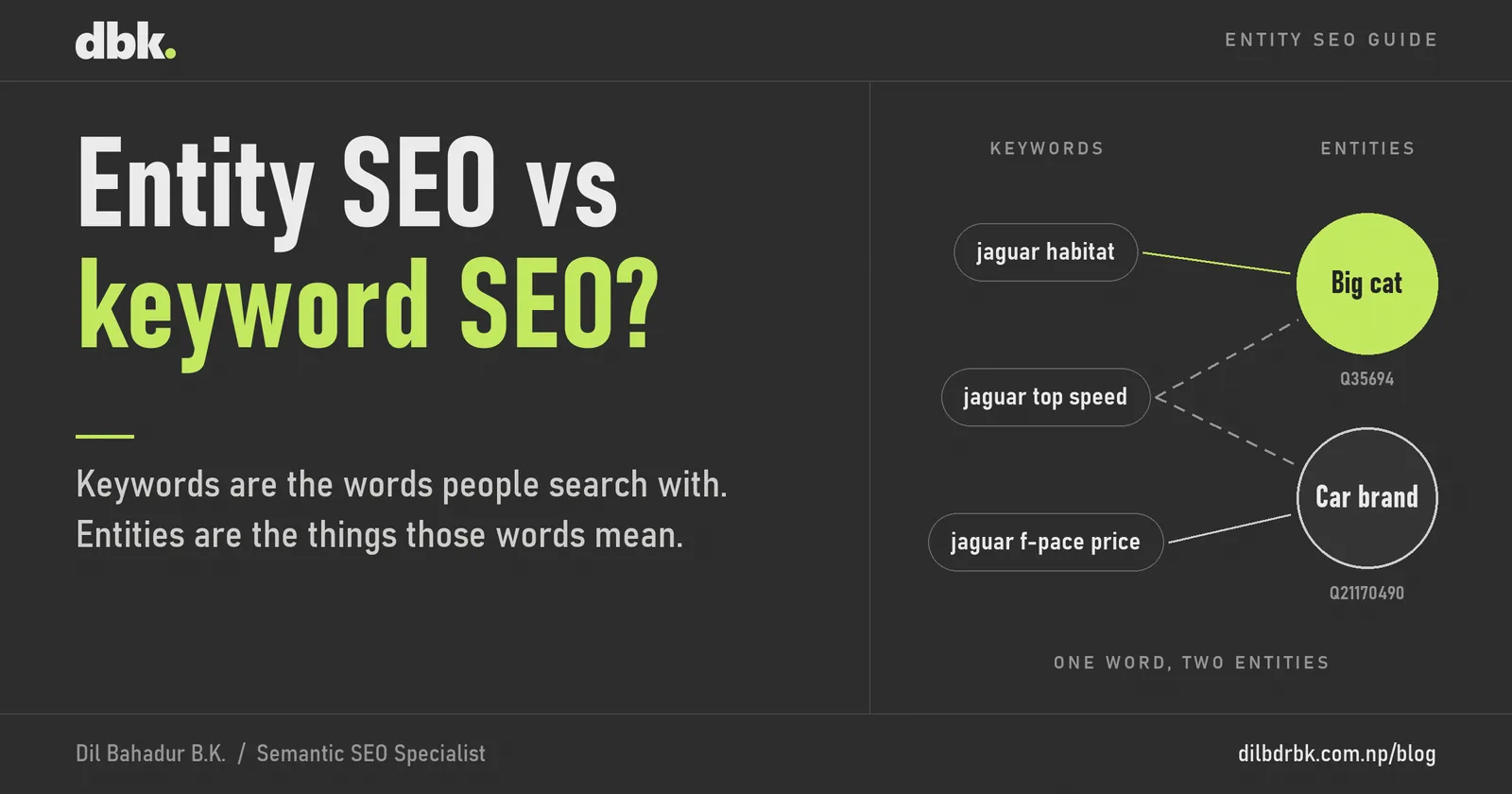 Entity SEO vs Keyword SEO: What Changes and What StaysEntity SEO vs keyword SEO: keywords show how people search, entities show what they mean. See the differences, where each works and how to combine them.Read the guide
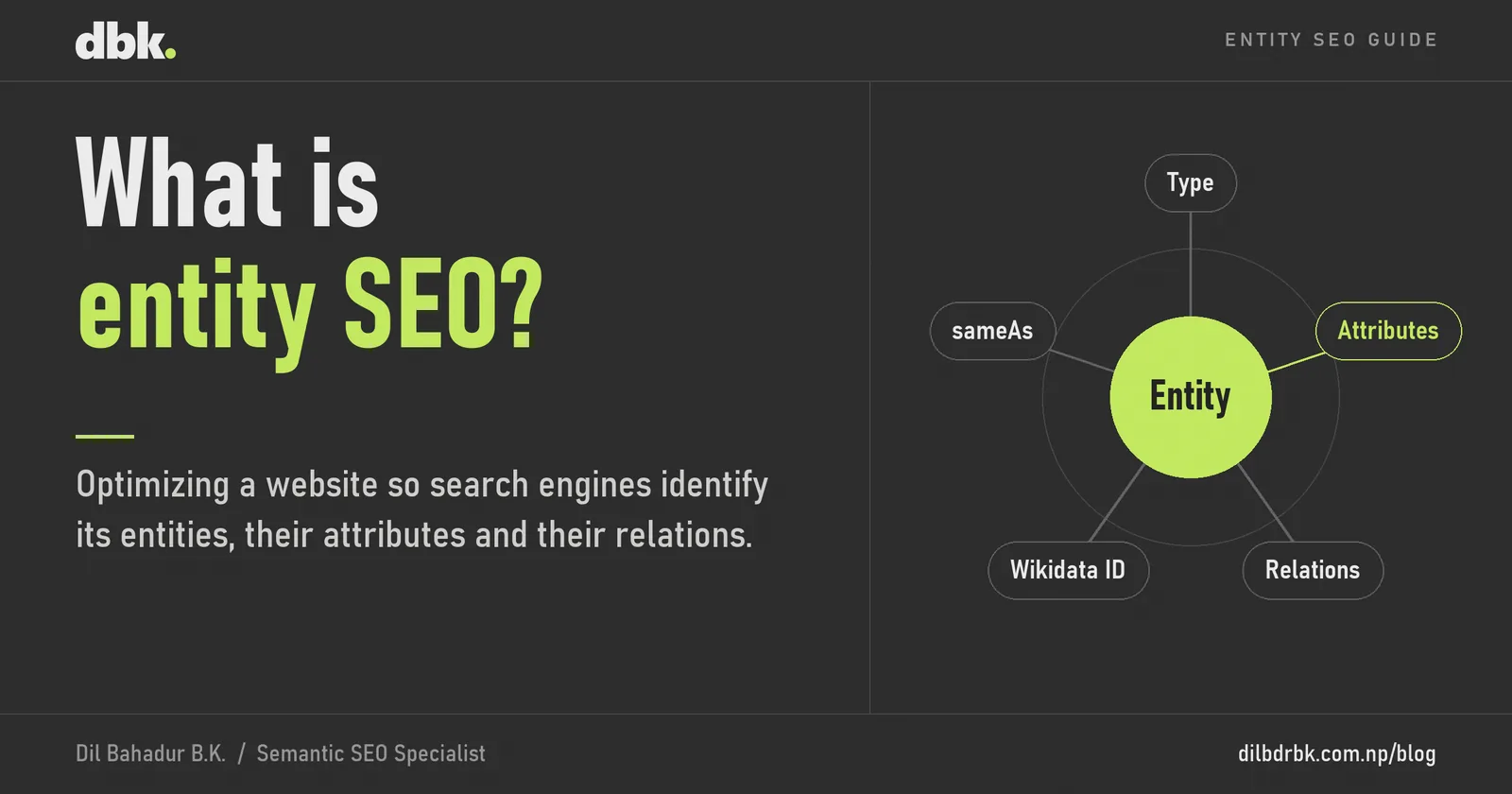 What Is Entity SEO? A Practical GuideEntity SEO helps search engines identify the people, places, products and concepts on your site. Learn how it works and how to do it in 6 steps.Read the guide
FAQ
What is semantic SEO?
Semantic SEO organizes a website around entities, their attributes and the questions people ask, so search engines understand what each page covers. It establishes topical authority through topical maps, structured content and clear internal links. Search engines such as Google then match the site to whole topics instead of single keywords, which widens the range of queries each page can rank for.
How is semantic SEO different from traditional SEO?
Traditional SEO targets one keyword per page, while semantic SEO targets the entity and its full network of related questions. A traditional page might chase one phrase, such as "plumber near me". A semantic plan covers the services, locations, prices and problems buyers search for and links them, so one site earns topical authority across the whole subject.
What kind of SEO does Dil specialize in?
Dil specializes in semantic, entity-based SEO backed by technical, local, on-page and off-page SEO. The work covers topical maps, content strategy, keyword research and link building, plus programmatic SEO and AI search optimization (GEO and AEO). Each project starts from an entity map, so every page has one clear topic, one intent and a planned place in the site.
Which industries has Dil done SEO for?
Dil has delivered SEO for more than 25 industries. Current projects include an e-commerce platform, heavy haul transport, closet and storage systems, mobile IV therapy, diesel engine parts, luxury car rental, house numbers and signs, and industrial process equipment. Earlier work covers twelve local service niches, such as plumbing, HVAC, flooring and pest control, and eight nationwide niches, such as IT, finance, real estate and SaaS.
Does Dil optimize for AI search such as ChatGPT and Google AI Overviews?
Yes. Dil structures content and entities so brands surface in AI-generated answers on ChatGPT, Gemini, Perplexity and Google's AI Overviews. Clear entity facts, consistent profiles and pages that each answer one question make a brand easier for these systems to cite. Reddit SEO extends that visibility across traditional and AI search.
How does Dil keep up with search engine changes?
Dil keeps up with search changes through daily checks, primary sources and live tests. Algorithm volatility sensors, such as Semrush Sensor and AccuRanker's Grump, get a check every day. Search engine patents, research papers, official statements and newsletters such as SEOFOMO add context, and SEO A/B tests separate facts from myths before any change reaches a client's site.
How can I contact Dil Bahadur B.K.?
Email [email protected], call +977 9810234765, or message Dil on LinkedIn. The Hire Me form on this site collects your name, website and goals in one place. Dil works from Nepal on Nepal Time (UTC+5:45) and replies to every message personally.
Ready to win more customers with semantic SEO?
Share your website and your goals. I read every message and reply myself.